However, I’ve been thinking about the figures Martin cites in his post, and especially about how the whole system is actually supposed to work. Official tourism reports often fall short of reality due to the gray economy, but anyone who has been on the island during the season can see the enormous influx. At the peak of the season, an estimate of
3,000 climbers per week is entirely realistic.
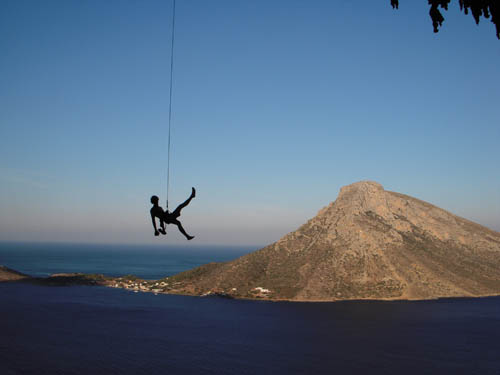 Roman Kučera (Kůča ) on the on-sight of Fun de Chichunne 8a
photo by František Jelínek
Roman Kučera (Kůča ) on the on-sight of Fun de Chichunne 8a
photo by František Jelínek
Taking into account both high and low seasons and rising accommodation prices, I arrive at the following calculation:
The average price of accommodation today is at least around 600 CZK (25 EUR) per person per night. For 3,000 climbers, that amounts to
12,600,000 CZK per week in accommodation costs alone.
When we add in the cost of snowmobile rentals, breakfast, shopping, and dinners at restaurants, the estimate of
50 EUR (1,200 CZK) per person per day is very conservative. The reality is often higher. That means an additional
25,200,000 CZK per week in direct spending.
In total, during the peak season, climbers spend around
37,800,000 CZK (1.5 million EUR) per week on Kalymnos.
Even if we take into account fluctuations outside the peak season, for a seven-month season we’re talking about amounts well over
half a billion CZK. And that’s a very conservative estimate—I’m not including plane tickets, ferries, or the fact that many spend much more. You can calculate for yourselves how much we’ve spent there over the last 10 years.
I’ve visited Kalymnos several times and spoken with the locals there. They all agree on one thing: without climbers, Kalymnos is a poor island just off the coast of Turkey. It was the climbing boom that brought job opportunities and money. Without us, it will once again be just a forgotten hole in the Aegean Sea. My personal opinion is that the safety of the routes should be the primary concern of those who benefit most from them—namely, the island of Kalymnos and its leadership. Investing in safe belaying is an investment in the future of their own business.
I’m no penny-pincher, and I’ve known Brumlu for over 30 years, but it doesn’t seem entirely fair to ask climbers to travel there, spend all that money, and then pay for their own belay equipment. If the Kalymnos administration allocated even just 0.1% of that money annually to maintaining the belay points, Péťa would still be alive and wouldn’t have to rely on handouts.
Rather than a financial contribution, a global boycott by climbers would help. It would be enough if no one came for just one year. The resulting loss of revenue would be so significant that we’d see how quickly the maintenance funding issue would be resolved. It would also send a message to other areas (Leonidio, Manikia, etc.) that if they don’t take care of route safety, we’ll stop spending money there.
There are hundreds of climbing areas by the sea. Are we going to subsidize them financially in the future as well? If so, you’d better start saving right now.



 Registration









 lezec.cz
 This article is in no way directed against Zéďa, who is my friend, nor against his activities in the field of route belaying. Every tragedy is a terrible experience for everyone involved, especially when it involves someone close to you. I, too, would likely try to resolve this problem as quickly and easily as possible, and my first step would definitely be to reach out to the climbing community and my friends for help.